CAPITULO 10: La Espada Invisible
ART ESP / ING
Palabras Clave: Línea sacra de los 7 monasterios, espada de San Miguel, Mont Saint-Michel, realeza francesa, santuarios arcángeles, geografía sagrada, alineación mística.
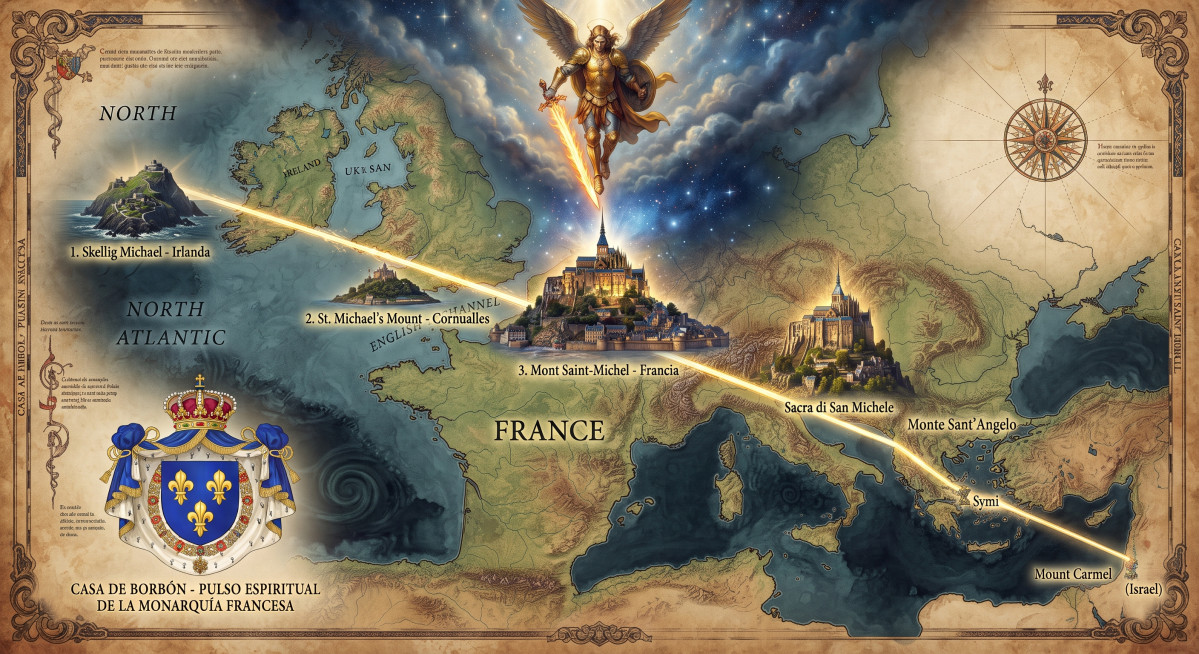
Existe en el mapa de Europa y Oriente Medio una traza invisible que desafía la lógica de la cartografía medieval y alimenta la fascinación de historiadores, geógrafos y buscadores de enigmas. Se trata de la denominada línea sacra de los 7 monasterios, una impresionante cadena de santuarios separados por cientos de kilómetros pero unidos por una precisión geométrica desconcertante.
Siete Enclaves para un Eje Celestial
El recorrido de esta misteriosa alineación comienza en el confín atlántico más occidental, en las costas escarpadas de Irlanda, donde se alza el monasterio de Skellig Michael. Tallado literalmente sobre peñascos inaccesibles azotados por el oleaje, este remoto refugio monástico marca el punto de partida de un trazado que serpentea hacia el sureste. La línea continúa su curso angélico cruzando el Canal de la Mancha para materializarse en St. Michael's Mount, en Cornualles, una isla mareal que parece replicar la geografía mística de su hermana mayor continental.
Tras atravesar los mares británicos, el trazado penetra en el continente europeo para alcanzar su máxima expresión monumental y simbólica en suelo francés. Desde allí, la ruta prosigue inexorable hacia el sur, dibujando un vector perfecto que atraviesa la imponente Sacra di San Michele en el Piamonte italiano, desciende hasta el célebre santuario de Monte Sant'Angelo en el Gargano apuliano —consagrado según la tradición por el propio arcángel—, salta hacia las aguas del Egeo para abrazar el monasterio de Symi en Grecia, y concluye su periplo milenario en el monasterio del Monte Carmelo en Israel. Lo verdaderamente turbador para la ciencia histórica es que la mayoría de estos emplazamientos fueron erigidos en épocas distintas, por culturas diversas y sin un conocimiento consciente de una red global, y sin embargo, sus coordenadas convergen en una línea recta que coincide de manera casi simétrica con la puesta de sol durante el solsticio de verano.
Mont Saint-Michel: El Núcleo Espiritual de la Monarquía Francesa
Si bien cada uno de los santuarios de la espada de San Miguel posee una impronta singular, el complejo levantado sobre el peñón normando de Mont Saint-Michel se alza de forma indiscutible como el eje neurálgico y el corazón espiritual de todo el sistema. En la Edad Media, este monte erigido en medio de mareas colosales dejó de ser un simple refugio de oración para convertirse en el epicentro ideológico y político de los reyes de Francia.
Para la dinastía capetiana y los sucesivos soberanos franceses, San Miguel no era meramente un protector celestial abstracto; constituía el estandarte místico de la legitimidad dinástica y de la soberanía del reino. El monarca francés encontraba en la figura del Príncipe de las Milicias Celestiales el espejo divino de su propia autoridad terrenal: un guerrero incorruptible que defendía las fronteras de la cristiandad frente al caos. Por esta razón, peregrinar a Mont Saint-Michel era un rito de paso casi obligatorio para los reyes, quienes acudían a postrarse ante el arcángel para refrendar sus coronaciones, agradecer victorias militares o buscar el favor divino en los momentos más oscuros de la historia nacional, como ocurrió durante los embates de la Guerra de los Cien Años.
La arquitectura de la abadía, conocida popularmente como la Maravilla de Occidente, refleja esta simbiosis entre el poder temporal y el trascendente. Sus muros inexpugnables, superpuestos en gradas imposibles sobre la roca viva, no solo desafiaban los embates del mar, sino que materializaban visualmente la jerarquía del cosmos: los cimientos se hunden en la tierra de los hombres, mientras que la aguja dorada culminada por la estatua del arcángel se proyecta directamente hacia el cielo. Para los reyes franceses, este bastión inexpugnable representaba la prueba tangible de que su reino contaba con la tutela directa del cielo, convirtiendo al monte normando en el sagrario político más importante de la corona.
Geometría, Mito y Legado de la Espada Invisible
El análisis de la línea sacra de los 7 monasterios trasciende el mero inventario arquitectónico para adentrarse en la psicología colectiva de la Europa medieval. En una época marcada por pestes, guerras y la constante amenaza de invasiones, la figura de San Miguel funcionaba como el gran dique de contención contra el mal. Los monasterios alineados bajo su advocación actuaban como faros espirituales, una muralla invisible de oración y vigilancia que recortaba el territorio europeo de noroeste a sureste.
El hecho de que el segmento francés actúe como la bisagra perfecta de este recorrido refuerza la tesis de que la geografía sagrada no era fruto del azar, sino de una profunda necesidad humana de ordenar el territorio bajo categorías cosmológicas. Los monjes benedictinos y los arquitectos medievales, guiados por un profundo dominio de la geometría y la teología simbólica, supieron leer el paisaje para convertirlo en un mapa de salvación.
Hoy en día, recorrer los vestigios de esta línea milenaria permite comprender cómo las sociedades del pasado esculpieron sus creencias sobre la piedra y el territorio. El eco de las mareas que golpean los cimientos de Mont Saint-Michel sigue resonando como un recordatorio de aquel tiempo en el que los reinos terrenales buscaban sostenerse en la punta de una espada celestial. Entre la leyenda de la batalla contra el dragón y la realidad de los cimientos imperiales franceses, la línea sacra permanece incólume, trazando en silencio el mapa secreto de la memoria europea.
The Invisible Sword: The Geographical Mystery of the Sacred Line of the Seven Monasteries and the Spiritual Pulse of France
Keywords: Sacred line of the 7 monasteries, sword of Saint Michael, Mont Saint-Michel, French royalty, archangel sanctuaries, sacred geography, mystical alignment.
There exists on the map of Europe and the Middle East an invisible trace that defies the logic of medieval cartography and feeds the fascination of historians, geographers, and seekers of enigmas. This is the so-called sacred line of the 7 monasteries, an impressive chain of sanctuaries separated by hundreds of kilometers yet united by a disconcerting geometric precision. Legend holds that this trace represents the precise and definitive blow that Archangel Saint Michael dealt to Lucifer, casting him into the abyss after the great celestial battle. Beyond the hagiographical myth, however, this millenary axis conceals one of the most fascinating chapters of Western spiritual, political, and architectural history, where the Gallic enclave undeniably emerges as the pulsing heart of monarchical power.
Seven Enclaves for a Celestial Axis
The journey of this mysterious alignment begins at the westernmost Atlantic confines on the rugged, wave-lashed shores of Ireland, where the monastery of Skellig Michael stands. Carved literally into inaccessible crags beaten by the surf, this remote monastic refuge marks the starting point of a trajectory winding toward the southeast. The line continues its angelic course across the English Channel to materialize at St. Michael's Mount in Cornwall, a tidal island that seems to mirror the mystical geography of its larger continental counterpart.
After crossing the British seas, the path penetrates the European continent to achieve its maximum monumental and symbolic expression on French soil. From there, the route proceeds inexorably southward, drawing a perfect vector that crosses the imposing Sacra di San Michele in the Italian Piedmont, descends to the celebrated sanctuary of Monte Sant'Angelo in the Apulian Gargano—consecrated according to tradition by the archangel himself—leaps toward the waters of the Aegean to embrace the monastery of Symi in Greece, and concludes its millenary journey at the monastery of Mount Carmel in Israel. What is truly unsettling for historical science is that most of these sites were erected in different eras, by diverse cultures, and without conscious knowledge of a global network, yet their coordinates converge in a straight line that coincides almost symmetrically with the sunset during the summer solstice.
Mont Saint-Michel: The Spiritual Nucleus of the French Monarchy
While each of the sanctuaries of Saint Michael's sword possesses a singular imprint, the complex built upon the Norman rock of Mont Saint-Michel stands indisputably as the neuralgic axis and spiritual heart of the entire system. In the Middle Ages, this mount rising amid colossal tides ceased to be a simple refuge of prayer to become the ideological and political epicenter of the kings of France.
For the Capetian dynasty and successive French sovereigns, Saint Michael was not merely an abstract celestial protector; he constituted the mystical standard of dynastic legitimacy and kingdom sovereignty. The French monarch found in the figure of the Prince of the Heavenly Host the divine mirror of his own earthly authority: an incorruptible warrior defending the borders of Christendom against chaos.
The architecture of the abbey, popularly known as the Wonder of the West, reflects this symbiosis between temporal and transcendent power. Its impregnable walls, superimposed in impossible tiers upon the living rock, not only defied the onslaughts of the sea but visually materialized the hierarchy of the cosmos: the foundations sink into the earth of men, while the golden spire crowned by the statue of the archangel projects directly toward the sky. For the French kings, this unyielding bastion represented tangible proof that their realm enjoyed the direct guardianship of heaven, turning the Norman mount into the most important political shrine of the crown.
Geometry, Myth, and the Legacy of the Invisible Sword
The analysis of the sacred line of the 7 monasteries transcends mere architectural inventory to delve into the collective psychology of medieval Europe. In an era marked by pestilence, wars, and the constant threat of invasions, the figure of Saint Michael functioned as the great dam against evil. The monasteries aligned under his patronage acted as spiritual beacons, an invisible wall of prayer and vigilance cutting across European territory from northwest to southeast.
The fact that the French segment acts as the perfect hinge of this journey reinforces the thesis that sacred geography was not the result of chance, but of a profound human need to order territory under cosmological categories. Benedictine monks and medieval architects, guided by a deep mastery of geometry and symbolic theology, knew how to read the landscape to transform it into a map of salvation.
Today, tracing the vestiges of this millenary line allows us to understand how societies of the past sculpted their beliefs onto stone and territory. The echo of the tides striking the foundations of Mont Saint-Michel continues to resonate as a reminder of that time when earthly realms sought support upon the tip of a celestial sword. Between the legend of the battle against the dragon and the reality of French imperial foundations, the sacred line remains undaunted, silently tracing the secret map of European memory.