El Esplendor y la Sombra: La Importancia de los Países Africanos para la Casa Real de Francia del Antiguo Régimen
ART ESP / ING
Palabras Clave: La importancia de los países africanos para la casa real de Francia del antiguo régimen, diplomacia de los Borbones en África, comercio triangular francés, Compañía del Senegal, mercantilismo francés, relaciones franco-africanas del siglo XVII, economía del Imperio francés.
Bajo los techos dorados y los deslumbrantes frescos del Palacio de Versalles, la corte de los reyes Borbones proyectaba una imagen de poder absoluto, refinamiento y autosuficiencia. Sin embargo, el resplandor del Rey Sol, Luis XIV, y de sus sucesores, Luis XV y Luis XVI, no se alimentaba únicamente de los campos de trigo de la campiña francesa o de los impuestos recaudados en París. A miles de kilómetros al sur, más allá del Mediterráneo y navegando a lo largo de las vastas y complejas costas atlánticas, se forjaba un vínculo vital e inquebrantable. Comprender la opulencia, la estrategia geopolítica y la supervivencia económica de la monarquía francesa requiere una mirada profunda hacia la importancia de los países africanos para la casa real de Francia del antiguo régimen.
Para la historiografía tradicional, la mirada de la monarquía francesa a menudo se ha centrado en sus rivalidades continentales con los Habsburgo o en sus dominios americanos en Nueva Francia y las Antillas. No obstante, África no era un mero punto de tránsito; era el motor invisible, el tablero de ajedrez diplomático y la despensa de recursos estratégicos sin los cuales el imperio atlántico francés colapsaría. Como en un meticuloso reloj, las naciones, reinos y territorios africanos proporcionaron las piezas esenciales para que la corona francesa mantuviera su estatus de superpotencia europea.
La visión de un imperio global comenzó a cristalizar bajo el mandato de Jean-Baptiste Colbert, el brillante y pragmático Ministro de Finanzas de Luis XIV. Colbert entendió que la verdadera riqueza de una nación residía en su capacidad para monopolizar el comercio y acumular metales preciosos, una doctrina conocida como mercantilismo. En este esquema, África emergía como una pieza insustituible. La fundación de la Compañía Francesa de las Indias Occidentales en 1664, y posteriormente la Compañía del Senegal y la Compañía de Guinea, no fueron aventuras de comerciantes independientes, sino empresas estatales aprobadas, financiadas y protegidas directamente por la Casa Real.
La corona exigía dividendos e imponía un estricto control sobre los asentamientos en lugares clave como San Luis (Saint-Louis) y la isla de Gorée, en el actual Senegal. La importancia de los países africanos para la casa real de Francia del antiguo régimen en el ámbito económico era incalculable. Por un lado, estaba la incesante demanda de goma arábiga, un recurso que hoy podría parecer trivial, pero que en los siglos XVII y XVIII era el oro blanco de la industria textil. La goma arábiga, cosechada en los bosques de acacias a lo largo del río Senegal y en las estepas mauritanas, era el único fijador eficaz para los tintes de la naciente y lujosa industria textil francesa de ciudades como Lyon y Rouen. Sin el control de este recurso africano, las manufacturas reales de Francia, motivo de orgullo y exportación de la monarquía, habrían perdido su competitividad frente a británicos y holandeses.
A la par, el oro proveniente de la región de Bambouk y de la Costa de Oro oxigenaba las exhaustas arcas de la tesorería real, permanentemente asediada por los costos de las guerras continentales. Pero el comercio más oscuro, complejo y lucrativo que ataba a los Borbones con África era, sin duda, el comercio transatlántico de personas esclavizadas. Las ricas colonias azucareras francesas en el Caribe, como Saint-Domingue (la actual Haití), Martinica y Guadalupe, generaban una riqueza sin precedentes que fluía directamente hacia los puertos franceses de Nantes, Burdeos y La Rochelle, y de ahí a las arcas reales mediante impuestos y aduanas.
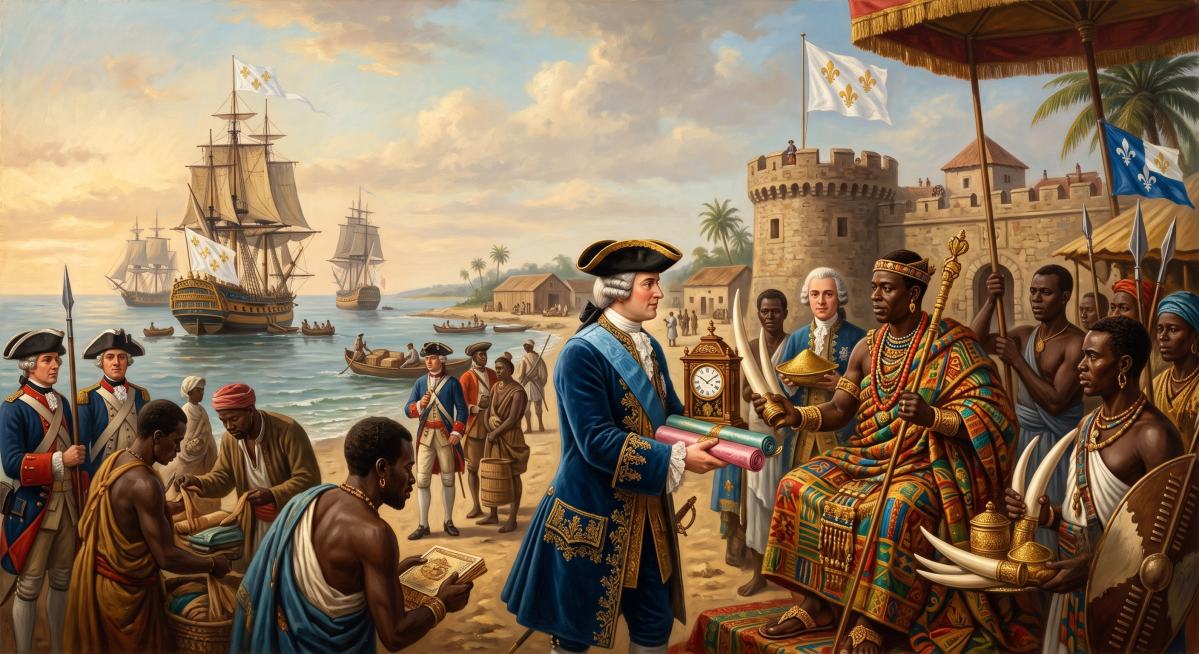
Este sistema de plantación dependía absoluta y trágicamente de la mano de obra africana. Por lo tanto, asegurar alianzas con los reinos y líderes africanos que controlaban las rutas comerciales hacia el interior del continente se convirtió en un asunto de Estado del más alto nivel. Los monarcas franceses despachaban emisarios no como conquistadores absolutos, ya que el equilibrio de poder en África Occidental recaía firmemente en los soberanos locales, sino como diplomáticos buscando favores. La Casa Real tenía que negociar de igual a igual con poderosas entidades políticas africanas como el Reino de Dahomey, el Imperio de Oyo o los distintos estados wolof y serer. Los regalos reales, a menudo armas de fuego finamente decoradas en las armerías de París, telas suntuosas y espejos, se enviaban con el sello de los Borbones a los líderes africanos para asegurar contratos de exclusividad comercial.
Este nivel de interacción diplomática nos lleva a un aspecto fascinante y a menudo ignorado de la importancia de los países africanos para la casa real de Francia del antiguo régimen: el intercambio cultural y la proyección imperial en la propia corte de Versalles. El interés de la corona iba más allá de las cifras contables; Luis XIV, el autoproclamado monarca universal, deseaba exhibir su influencia sobre los reinos lejanos ante los embajadores europeos.
El caso más ilustrativo de esta diplomacia performativa fue la llegada de Aniaba, un joven noble del reino de Assinie (ubicado en la actual Costa de Marfil), a la corte francesa a finales del siglo XVII. Llegado a Francia en 1687, el joven fue presentado a Luis XIV. El Rey Sol no lo trató como un mero vasallo, sino que lo apadrinó personalmente. Aniaba fue educado en las costumbres cortesanas, bautizado en la fe católica con el mismísimo Luis XIV como su padrino y el prominente clérigo Bossuet oficiando la ceremonia. Recibió el rango de oficial en la caballería francesa y fue condecorado con la Orden de la Estrella de Nuestra Señora del Monte Carmelo.
Cuando la corona francesa financió su viaje de regreso a Assinie en 1701, el objetivo de Luis XIV no era altruista. La intención era coronar a un rey católico, educado en Versalles y leal a los Borbones, en la costa de África Occidental, garantizando así un enclave estratégico inexpugnable para los intereses franceses y cerrando el paso a los holandeses. Aunque el plan no fructificó como se esperaba una vez que Aniaba regresó a su tierra, el episodio subraya cómo la diplomacia africana ocupaba la mente del rey y la energía del estado absolutista.
A lo largo del siglo XVIII, durante los reinados de Luis XV y Luis XVI, la importancia estratégica de África solo se intensificó. El continente se convirtió en un frente más de la incipiente guerra mundial entre Francia y Gran Bretaña. La Guerra de los Siete Años (1756-1763), que devastó las finanzas francesas y vio la pérdida de Canadá y gran parte de la influencia en la India, también tuvo episodios cruciales en la costa senegalesa. La pérdida de la isla de Gorée y de San Luis a manos de los británicos fue vista como una catástrofe en París, no solo por la pérdida de prestigio, sino por el golpe económico al suministro de mano de obra para las Antillas y de goma arábiga para la metrópoli.
La recuperación de estos enclaves tras la intervención francesa en la Guerra de Independencia de los Estados Unidos (formalizada en el Tratado de Versalles de 1783) fue celebrada por la corte de Luis XVI como una victoria fundamental. El envío de gobernadores reales, como el Chevalier de Boufflers a Senegal en 1785, demuestra que en el crepúsculo del Antiguo Régimen, la monarquía estaba realizando esfuerzos considerables para reestructurar, asegurar y expandir su huella africana. Boufflers, un hombre de letras y figura destacada de los salones parisinos, actuó como el administrador del rey en el terreno, intentando establecer plantaciones agrícolas y reforzando las alianzas con los líderes africanos locales para asegurar que las rutas comerciales fluyeran sin interrupciones hacia Francia.
La intrincada red que unía el destino de Francia con África era tan profunda que las leyes promulgadas desde el palacio real intentaban codificar la vida y la muerte en el otro lado del océano atlántico. El infame "Code Noir" (Código Negro), emitido por orden de Luis XIV en 1685 y redactado bajo la influencia de Colbert y su hijo, fue el intento definitivo de la monarquía absoluta de regular el estado legal, las condiciones de vida y los castigos de las poblaciones esclavizadas de origen africano en las colonias americanas, así como la expulsión de los judíos de las mismas. Este documento legal, oscuro testamento de la época, evidencia que la corona reconocía que su hegemonía económica global dependía intrínsecamente del control sobre los cuerpos y el trabajo de millones de africanos.
Por otro lado, la fascinación estética e intelectual por África también permeó la sociedad del Antiguo Régimen. Las narrativas de exploradores financiados por el Estado real, las colecciones de cartografía de la Biblioteca Real y los gabinetes de curiosidades de los nobles se llenaron de artefactos africanos. La Casa Real de Francia patrocinaba misiones e investigaciones que buscaban mapear el interior del continente, obsesionados con los rumores de las ciudades doradas del interior y las rutas del legendario Tombuctú. La monarquía financiaba la "ciencia" de la época no por pura sed de conocimiento, sino para obtener ventajas cartográficas que se traducirían en tratados comerciales ventajosos.
En conclusión, observar a la monarquía francesa pre-revolucionaria únicamente a través de su política europea es comprender solo la mitad de la historia. La importancia de los países africanos para la casa real de Francia del antiguo régimen fue el pilar oculto que sostuvo gran parte del esplendor, la economía, la guerra y la política exterior del Estado absolutista. Desde los tintes que coloreaban los vestidos de la nobleza en Versalles y el azúcar que endulzaba sus tazas de café, hasta el oro que pagaba a sus soldados y las alianzas diplomáticas que desafiaban al Imperio Británico; África estuvo presente en cada decisión de la corona.
Lejos de ser un telón de fondo pasivo, los reinos, líderes, comerciantes y personas del continente africano determinaron el ritmo del éxito y del fracaso de la Francia borbónica. Al caer la guillotina sobre el Antiguo Régimen en 1789, los revolucionarios heredaron no solo un país en bancarrota, sino un vasto y complejo entramado de intereses, comercio y explotación transatlántica centrado en África, un legado que definiría la posterior, y aún más agresiva, etapa del colonialismo europeo en el siglo XIX. Reconocer esta historia es vital para desentrañar los verdaderos cimientos sobre los que se construyeron los grandes imperios de la Europa moderna.
The Splendor and the Shadow: The Importance of African Countries to the French Royal House of the Ancien Régime
Keywords: The importance of African countries to the French royal house of the Ancien Régime, Bourbon diplomacy in Africa, French triangular trade, Senegal Company, French mercantilism, 17th-century Franco-African relations, economy of the French Empire.
Beneath the gilded ceilings and dazzling frescoes of the Palace of Versailles, the court of the Bourbon kings projected an image of absolute power, refinement, and self-sufficiency. However, the radiance of the Sun King, Louis XIV, and his successors, Louis XV and Louis XVI, was not solely fueled by the wheat fields of the French countryside or the taxes collected in Paris. Thousands of miles to the south, beyond the Mediterranean and navigating along the vast and complex Atlantic coasts, a vital and unbreakable bond was being forged. Understanding the opulence, geopolitical strategy, and economic survival of the French monarchy requires a deep look at the importance of African countries to the French Royal House of the Ancien Régime.
For traditional historiography, the gaze of the French monarchy has often been focused on its continental rivalries with the Habsburgs or its American domains in New France and the West Indies. However, Africa was not a mere transit point; it was the invisible engine, the diplomatic chessboard, and the pantry of strategic resources without which the French Atlantic empire would collapse. Like a meticulous clock, African nations, kingdoms, and territories provided the essential pieces for the French crown to maintain its status as a European superpower.
The vision of a global empire began to crystallize under the tenure of Jean-Baptiste Colbert, Louis XIV's brilliant and pragmatic Minister of Finance. Colbert understood that the true wealth of a nation lay in its ability to monopolize trade and accumulate precious metals, a doctrine known as mercantilism. In this scheme, Africa emerged as an irreplaceable piece. The founding of the French West India Company in 1664, and later the Senegal Company and the Guinea Company, were not adventures of independent merchants, but state enterprises directly approved, funded, and protected by the Royal House.
The crown demanded dividends and imposed strict control over settlements in key locations such as Saint-Louis and the island of Gorée, in modern-day Senegal. The importance of African countries to the French Royal House of the Ancien Régime in the economic sphere was incalculable. On one hand, there was the incessant demand for gum arabic, a resource that today might seem trivial, but which in the 17th and 18th centuries was the white gold of the textile industry. Gum arabic, harvested in the acacia forests along the Senegal River and on the Mauritanian steppes, was the only effective fixative for the dyes of the nascent and luxurious French textile industry in cities like Lyon and Rouen. Without control of this African resource, the royal manufactures of France, a source of pride and export for the monarchy, would have lost their competitiveness against the British and the Dutch.
At the same time, gold from the Bambouk region and the Gold Coast oxygenated the exhausted coffers of the royal treasury, permanently besieged by the costs of continental wars. But the darkest, most complex, and most lucrative trade that tied the Bourbons to Africa was undoubtedly the transatlantic trade of enslaved people. The wealthy French sugar colonies in the Caribbean, such as Saint-Domingue (modern-day Haiti), Martinique, and Guadeloupe, generated unprecedented wealth that flowed directly to the French ports of Nantes, Bordeaux, and La Rochelle, and from there to the royal coffers through taxes and customs.
This plantation system depended absolutely and tragically on African labor. Therefore, securing alliances with the African kingdoms and leaders who controlled the trade routes to the interior of the continent became a matter of state of the highest level. French monarchs dispatched emissaries not as absolute conquerors, since the balance of power in West Africa rested firmly with local sovereigns, but as diplomats seeking favors. The Royal House had to negotiate as equals with powerful African political entities such as the Kingdom of Dahomey, the Oyo Empire, or the various Wolof and Serer states. Royal gifts, often finely decorated firearms from the armories of Paris, sumptuous fabrics, and mirrors, were sent bearing the Bourbon seal to African leaders to secure exclusive commercial contracts.
This level of diplomatic interaction leads us to a fascinating and often ignored aspect of the importance of African countries to the French Royal House of the Ancien Régime: cultural exchange and imperial projection within the court of Versailles itself. The crown's interest went beyond accounting figures; Louis XIV, the self-proclaimed universal monarch, wished to exhibit his influence over distant kingdoms to European ambassadors.
The most illustrative case of this performative diplomacy was the arrival of Aniaba, a young nobleman from the Kingdom of Assinie (located in modern-day Ivory Coast), at the French court at the end of the 17th century. Arriving in France in 1687, the young man was presented to Louis XIV. The Sun King did not treat him as a mere vassal but personally sponsored him. Aniaba was educated in courtly customs, baptized into the Catholic faith with Louis XIV himself as his godfather and the prominent cleric Bossuet officiating the ceremony. He received the rank of officer in the French cavalry and was decorated with the Order of the Star of Our Lady of Mount Carmel.
When the French crown funded his return trip to Assinie in 1701, Louis XIV's objective was not altruistic. The intention was to crown a Catholic king, educated in Versailles and loyal to the Bourbons, on the coast of West Africa, thereby guaranteeing an impregnable strategic enclave for French interests and blocking the way for the Dutch. Although the plan did not come to fruition as expected once Aniaba returned to his homeland, the episode underscores how African diplomacy occupied the mind of the king and the energy of the absolutist state.
Throughout the 18th century, during the reigns of Louis XV and Louis XVI, the strategic importance of Africa only intensified. The continent became yet another front in the incipient world war between France and Great Britain. The Seven Years' War (1756-1763), which devastated French finances and saw the loss of Canada and much of its influence in India, also had crucial episodes on the Senegalese coast. The loss of the island of Gorée and Saint-Louis to the British was seen as a catastrophe in Paris, not only because of the loss of prestige but due to the economic blow to the supply of labor for the West Indies and gum arabic for the metropolis.
The recovery of these enclaves following French intervention in the American Revolutionary War (formalized in the Treaty of Versailles of 1783) was celebrated by the court of Louis XVI as a fundamental victory. The dispatch of royal governors, such as the Chevalier de Boufflers to Senegal in 1785, demonstrates that in the twilight of the Ancien Régime, the monarchy was making considerable efforts to restructure, secure, and expand its African footprint. Boufflers, a man of letters and a prominent figure in Parisian salons, acted as the king's administrator on the ground, attempting to establish agricultural plantations and reinforcing alliances with local African leaders to ensure that trade routes flowed uninterrupted toward France.
The intricate web that bound the fate of France with Africa was so deep that laws enacted from the royal palace attempted to codify life and death on the other side of the Atlantic Ocean. The infamous "Code Noir" (Black Code), issued by order of Louis XIV in 1685 and drafted under the influence of Colbert and his son, was the absolute monarchy's definitive attempt to regulate the legal status, living conditions, and punishments of enslaved populations of African descent in the American colonies, as well as the expulsion of Jews from them. This legal document, a dark testament to the era, proves that the crown recognized that its global economic hegemony was inherently dependent on the control over the bodies and labor of millions of Africans.
On the other hand, aesthetic and intellectual fascination with Africa also permeated Ancien Régime society. The narratives of explorers funded by the royal state, the cartography collections of the Royal Library, and the cabinets of curiosities of the nobility were filled with African artifacts. The French Royal House sponsored missions and research seeking to map the interior of the continent, obsessed with rumors of golden inland cities and the routes to the legendary Timbuktu. The monarchy funded the "science" of the time not out of a pure thirst for knowledge, but to gain cartographic advantages that would translate into advantageous commercial treaties.
In conclusion, viewing the pre-revolutionary French monarchy solely through its European politics is to understand only half the story. The importance of African countries to the French Royal House of the Ancien Régime was the hidden pillar that supported much of the splendor, economy, warfare, and foreign policy of the absolutist state. From the dyes that colored the nobility's dresses in Versailles and the sugar that sweetened their cups of coffee, to the gold that paid its soldiers and the diplomatic alliances that challenged the British Empire; Africa was present in every decision of the crown.
Far from being a passive backdrop, the kingdoms, leaders, merchants, and people of the African continent determined the rhythm of success and failure for Bourbon France. When the guillotine fell on the Ancien Régime in 1789, the revolutionaries inherited not only a bankrupt country but a vast and complex network of transatlantic interests, trade, and exploitation centered in Africa, a legacy that would define the subsequent, and even more aggressive, stage of European colonialism in the 19th century. Acknowledging this history is vital to unraveling the true foundations upon which the great empires of modern Europe were built.