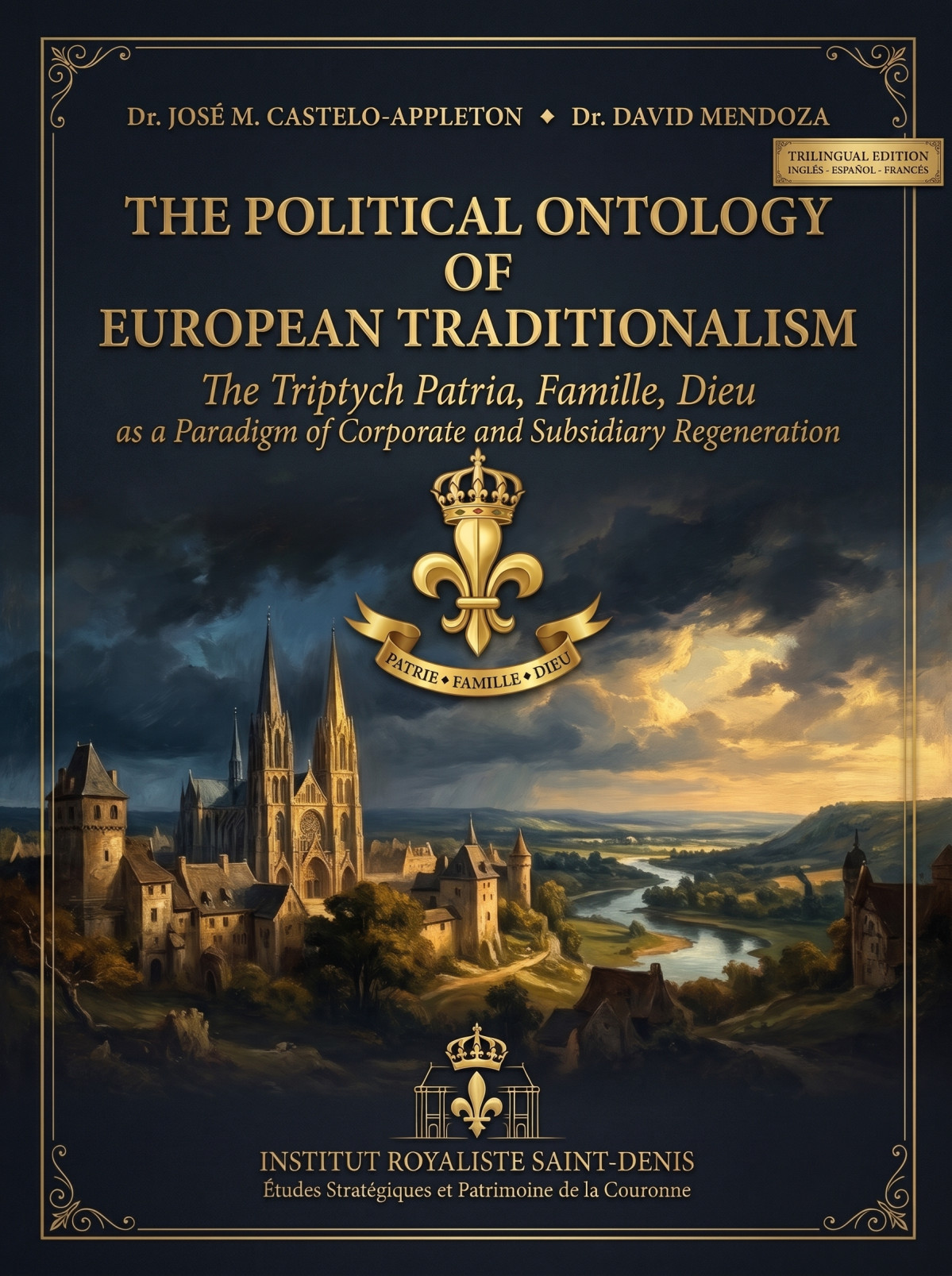
'Patria, Familia y Dios' como paradigma de regeneración corporativa y subsidiaria frente a la crisis del Estado liberal-tecnocrático
ART ESP / ING
La investigación, desarrollada por los doctores José M. Castelo-Appleton y David Mendoza desde el Instituto Fidélité et Espérance, fundamenta el tríptico «Patria, Familia y Dios» como arquitectura institucional de regeneración corporativa y subsidiaria para el continente.
París / Madrid, 10 de noviembre de 2026. La Casa Real de Francia, a través de su Departamento de Estudios Estratégicos y Filosofía Política del Instituto Fidélité et Espérance, hace pública la invitación a la comunidad académica, a los cuerpos representativos y a la sociedad civil europea a conocer la publicación del estudio de investigación titulado: «La ontología política del tradicionalismo europeo: El tríptico 'Patria, Familia y Dios' como paradigma de regeneración corporativa y subsidiaria frente a la crisis del Estado liberal-tecnocrático», coautorado por el Dr. José M. Castelo-Appleton y el Dr. David Mendoza.
El documento aborda de forma exhaustiva las causas estructurales del declive contemporáneo de Europa, diagnosticando tres fallas sistémicas que amenazan la continuidad histórica de las naciones del continente: el colapso demográfico sostenido, la pérdida de soberanía real en favor de agencias tecnocráticas no electas y la anomia espiritual provocada por la secularización radical del derecho y de las instituciones públicas. Frente a los paliativos coyunturales del consenso liberal y la socialdemocracia gerencial, la monografía rescata y actualiza el corpus doctrinal del pensamiento tradicionalista y contrarrevolucionario europeo (Joseph de Maistre, Louis de Bonald, Juan Donoso Cortés, René de La Tour du Pin y Francisco Elías de Tejada).
Entre las aportaciones capitales del estudio destacan:
- El fundamento trascendente (Dios) como límite al poder positivo: La corroboración histórica de la ley donosiana demuestra que la erradicación del principio metafísico del orden público no genera neutralidad axiológica, sino una hipertrofia del aparato sancionador y de la vigilancia burocrática sobre la vida privada.
- La soberanía familiar como pilar de continuidad civilizatoria: El análisis empírico valida las tesis bonaldianas al demostrar que la atomización individualista y la penalización fiscal del hogar constituyen la causa directa del invierno demográfico europeo. Se plantea la reforma hacia un cociente familiar integral, la supresión de los impuestos sucesorios sobre el patrimonio de estirpe y la plena restitución de la patria potestad educativa.
- La reconstrucción de la Patria mediante corporativismo y subsidiariedad ascendente: Superando la falsa dicotomía entre el centralismo jacobino y la gobernanza supranacional despersonalizada, se formula una arquitectura institucional basada en el reconocimiento jurídico-público de los cuerpos intermedios (gremios, universidades, colegios de oficios y municipios) y un sistema bicameral de representación orgánica frente a la partidocracia inorgánica.
Con esta iniciativa, la Casa Real de Francia reafirma su compromiso con el debate intelectual riguroso y la preservación del patrimonio institucional de Europa, ofreciendo una matriz doctrinal sólida destinada a inspirar reformas estructurales orientadas al bien común, la libertad concreta y la soberanía comunitaria.
El documento íntegro se encuentra a disposición de centros universitarios, círculos doctrinales y medios de comunicación a través de los canales institucionales del Instituto Fidélité et Espérance.
THE ROYAL HOUSE OF FRANCE INVITES THE ACADEMIC COMMUNITY AND CIVIL SOCIETY TO EXAMINE THE STRATEGIC STUDY "THE POLITICAL ONTOLOGY OF EUROPEAN TRADITIONALISM"
The research, authored by Dr. José M. Castelo-Appleton and Dr. David Mendoza of the Institut Fidélité et Espérance, establishes the triptych "Fatherland, Family, and God" as an institutional architecture for corporate and subsidiary regeneration.
Paris / Madrid, November 10, 2026. The Royal House of France, through the Department of Strategic Studies and Political Philosophy of the Institut Fidélité et Espérance, formally invites the international academic community, representative institutions, and European civil society to examine the strategic monograph titled: "The Political Ontology of European Traditionalism: The Triptych 'Fatherland, Family, and God' as a Paradigm of Corporate and Subsidiary Regeneration Against the Crisis of the Liberal-Technocratic State", co-authored by Dr. José M. Castelo-Appleton and Dr. David Mendoza.
The document delivers a comprehensive diagnosis of the structural causes underpinning the contemporary decline of Europe, addressing three systemic fractures that jeopardize the historical continuity of continental nations: persistent demographic collapse, the substantive erosion of sovereignty transferred to unelected technocratic agencies, and axiological anomie stemming from the radical secularization of law and public institutions. Rejecting the inadequate remedies offered by managerial social democracy and conventional liberal conservatism, the study restores and modernizes the doctrinal foundation of classical counter-revolutionary and traditionalist thought (Joseph de Maistre, Louis de Bonald, Juan Donoso Cortés, René de La Tour du Pin, and Francisco Elías de Tejada).
Key findings and proposals presented in the research include:
- The Transcendent Principle (God) as an Inviolable Boundary to Positive Power: The empirical verification of Donoso Cortés's thermodynamic law of order demonstrates that the elimination of metaphysical roots from the public sphere produces functional illimitation, digital surveillance, and punitive administrative overreach rather than benign neutrality.
- Domestic Sovereignty (Family) as the Bedrock of Civilizational Survival: The investigation substantiates Louis de Bonald's sociological doctrine, linking individualistic atomization and inheritance tax burdens to Europe's acute fertility deficit. It proposes an extended family quotient system, total exemption for intergenerational family assets, and the full restitution of parental authority over education.
- The Organic Fatherland Grounded in Corporatism and Ascendant Subsidiarity: Transcending the false opposition between Jacobin centralism and borderless technocratic governance, the model outlines a bottom-up institutional design featuring public-law recognition for intermediate bodies (guilds, trade associations, universities, and historic municipalities) alongside an upper chamber of organic representation to counterbalance party monopolies.
Through this publication, the Royal House of France confirms its dedication to rigorous intellectual inquiry and the defense of European civilizational heritage, delivering an operational matrix designed to guide systemic reform anchored in genuine subsidiarity, rooted liberty, and historical continuity.
The complete text is accessible to research institutions, university departments, and the press through the official channels of the Institut Fidélité et Espérance.