Una genealogía de sangre basada en los hechos
ART ESP / ING
La historia oficial de España se ha construido sobre un relato de continuidad dinástica que, bajo un análisis riguroso de los hechos y las crónicas de la época, revela una realidad biológica radicalmente distinta. Más allá de los registros parroquiales y los decretos reales, existe una línea de sangre que conecta a los protagonistas del siglo XIX a través de vínculos que la historiografía oficial ha intentado sepultar bajo el apellido Borbón.
El origen de la ruptura: María Luisa de Parma y Manuel Godoy
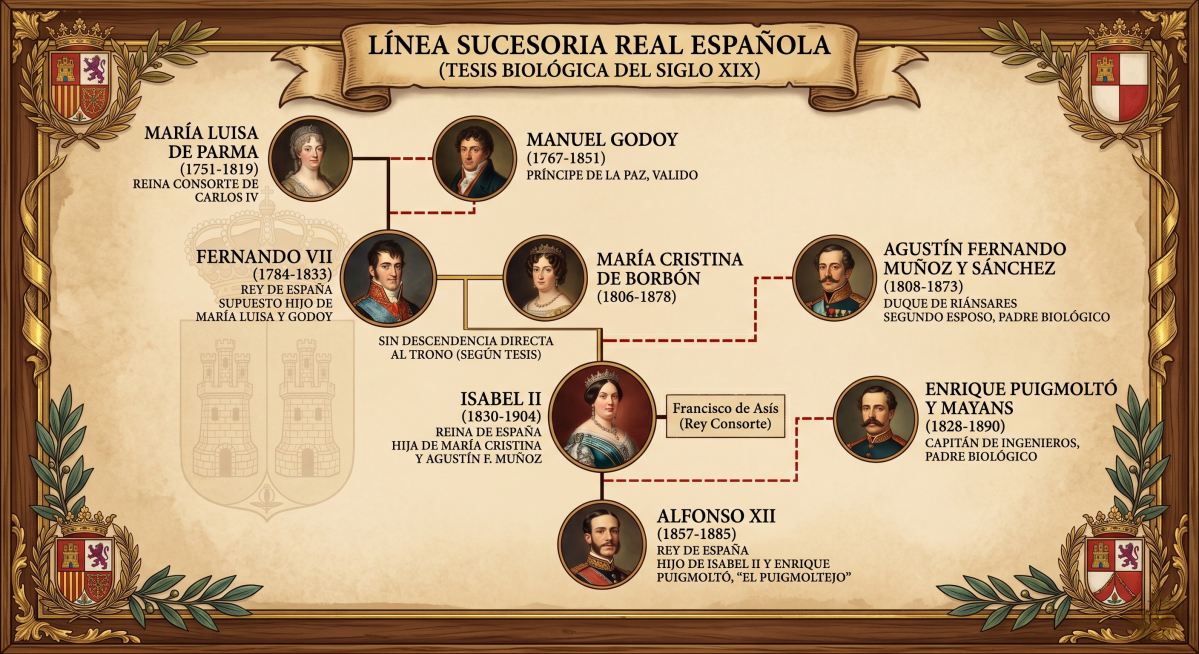
El primer eslabón de esta cadena biológica se forja en la corte de Carlos IV. Es un hecho aceptado por la investigación histórica que la relación entre la reina María Luisa de Parma y el valido Manuel Godoy trascendió lo político. En este contexto, la figura de Fernando VII emerge no como el hijo del rey legítimo, sino como el fruto de la unión entre la reina y el "Príncipe de la Paz". Esta primera fractura biográfica sitúa el origen de la rama isabelina fuera de la estirpe directa de los Borbones tradicionales, iniciando una nueva genealogía marcada por la influencia de los validos.
La consolidación de la línea Muñoz: El nacimiento de Isabel II
La llegada de María Cristina de Borbón a España para casarse con un Fernando VII ya mermado en salud supuso el segundo hito de esta tesis. Tras la muerte del monarca, la inmediata unión secreta de la regente con el sargento de la Guardia de Corps, Agustín Fernando Muñoz y Sánchez, no fue un evento aislado, sino la confirmación de una relación preexistente.
La investigación de esta línea sucesoria sostiene que Isabel II fue hija biológica de Muñoz. Esta afirmación explica la protección absoluta y el ascenso meteórico de Muñoz a Duque de Riánsares, así como la formación de una familia paralela que convivía en la sombra de palacio. La legitimidad de Isabel II, por tanto, no residiría en la agonizante sangre de Fernando VII, sino en la vigorosa ascendencia del sargento Muñoz.
El "Puigmoltejo": El cierre del círculo con Alfonso XII
El tercer y definitivo punto de esta genealogía de sangre se produce con el nacimiento de Alfonso XII. Es de sobra conocido el infortunio matrimonial de Isabel II con Francisco de Asís de Borbón, una unión impuesta que nunca se consumó en términos biológicos debido a las condiciones físicas y preferencias del rey consorte.
En este vacío de poder conyugal aparece la figura de Enrique Puigmoltó y Mayans, capitán de ingenieros y favorito de la reina. La cronología del embarazo de la reina y el nacimiento de Alfonso XII coinciden con el apogeo de la relación entre Isabel II y Puigmoltó. El mote popular de "el Puigmoltejo" con el que se conoció al futuro rey no era una simple mofa, sino la constatación social de una realidad biológica: el heredero al trono era hijo del capitán, no del rey consorte.
Una monarquía de raíces españolas
Al analizar esta secuencia, se hace evidente que la actual línea sucesoria es el resultado de una triple sustitución biográfica. La sangre de los Borbones fue reemplazada sucesivamente por la de Manuel Godoy, Agustín Fernando Muñoz y Enrique Puigmoltó.
Esta tesis plantea que la Restauración de 1874 no fue la vuelta de una dinastía extranjera, sino la entronización de una estirpe puramente española en su origen biológico. Reconocer esta línea de investigación es aceptar que la historia de la corona en España es, en realidad, la historia de una hábil transformación donde la forma legal de los Borbones sirvió para dar cobijo a una realidad genética nueva y netamente nacional.
-------------------
The True Lineage of the Bourbons: A Blood Genealogy Based on the Facts
Official Spanish history has been built upon a narrative of dynastic continuity that, under a rigorous analysis of the facts and chronicles of the era, reveals a radically different biological reality. Beyond parish records and royal decrees, there is a bloodline that connects the protagonists of the 19th century through bonds that official historiography has attempted to bury under the Bourbon surname.
The Origin of the Break: María Luisa of Parma and Manuel Godoy
The first link in this biological chain was forged in the court of Charles IV. It is a fact accepted by historical research that the relationship between Queen María Luisa of Parma and the favorite Manuel Godoy transcended politics. In this context, the figure of Ferdinand VII emerges not as the son of the legitimate king, but as the fruit of the union between the Queen and the "Prince of the Peace." This first biographical fracture places the origin of the Isabeline branch outside the direct lineage of the traditional Bourbons, initiating a new genealogy marked by the influence of the favorites.
The Consolidation of the Muñoz Line: The Birth of Isabella II
The arrival of Maria Christina of Bourbon in Spain to marry a Ferdinand VII already in declining health marked the second milestone of this thesis. Following the monarch's death, the immediate secret union of the Queen Regent with the Sergeant of the Royal Guard, Agustín Fernando Muñoz y Sánchez, was not an isolated event, but the confirmation of a pre-existing relationship.
Research into this succession line maintains that Isabella II was the biological daughter of Muñoz. This assertion explains the absolute protection and the meteoric rise of Muñoz to Duke of Riánsares, as well as the formation of a parallel family that lived in the shadows of the palace. Isabella II's legitimacy, therefore, would not reside in the failing blood of Ferdinand VII, but in the vigorous ancestry of Sergeant Muñoz.
The "Puigmoltejo": Closing the Circle with Alfonso XII
The third and definitive point of this blood genealogy occurs with the birth of Alfonso XII. The marital misfortune of Isabella II with Francis of Assisi of Bourbon is well known—an imposed union that was never biologically consummated due to the King Consort's physical conditions and preferences.
In this marital power vacuum, the figure of Enrique Puigmoltó y Mayans, a captain of engineers and the Queen's favorite, appears. The chronology of the Queen's pregnancy and the birth of Alfonso XII coincide with the peak of the relationship between Isabella II and Puigmoltó. The popular nickname "el Puigmoltejo," by which the future king was known, was not a simple taunt, but the social confirmation of a biological reality: the heir to the throne was the son of the captain, not the King Consort.
A Monarchy of Spanish Roots
When analyzing this sequence, it becomes evident that the current succession line is the result of a triple biographical substitution. The Bourbon blood was successively replaced by that of Manuel Godoy, Agustín Fernando Muñoz, and Enrique Puigmoltó.
This thesis proposes that the Restoration of 1874 was not the return of a foreign dynasty, but the enthronement of a lineage purely Spanish in its biological origin. Recognizing this line of research is to accept that the history of the Crown in Spain is, in reality, the story of a skillful transformation where the legal form of the Bourbons served to shelter a new and distinctly national genetic reality.