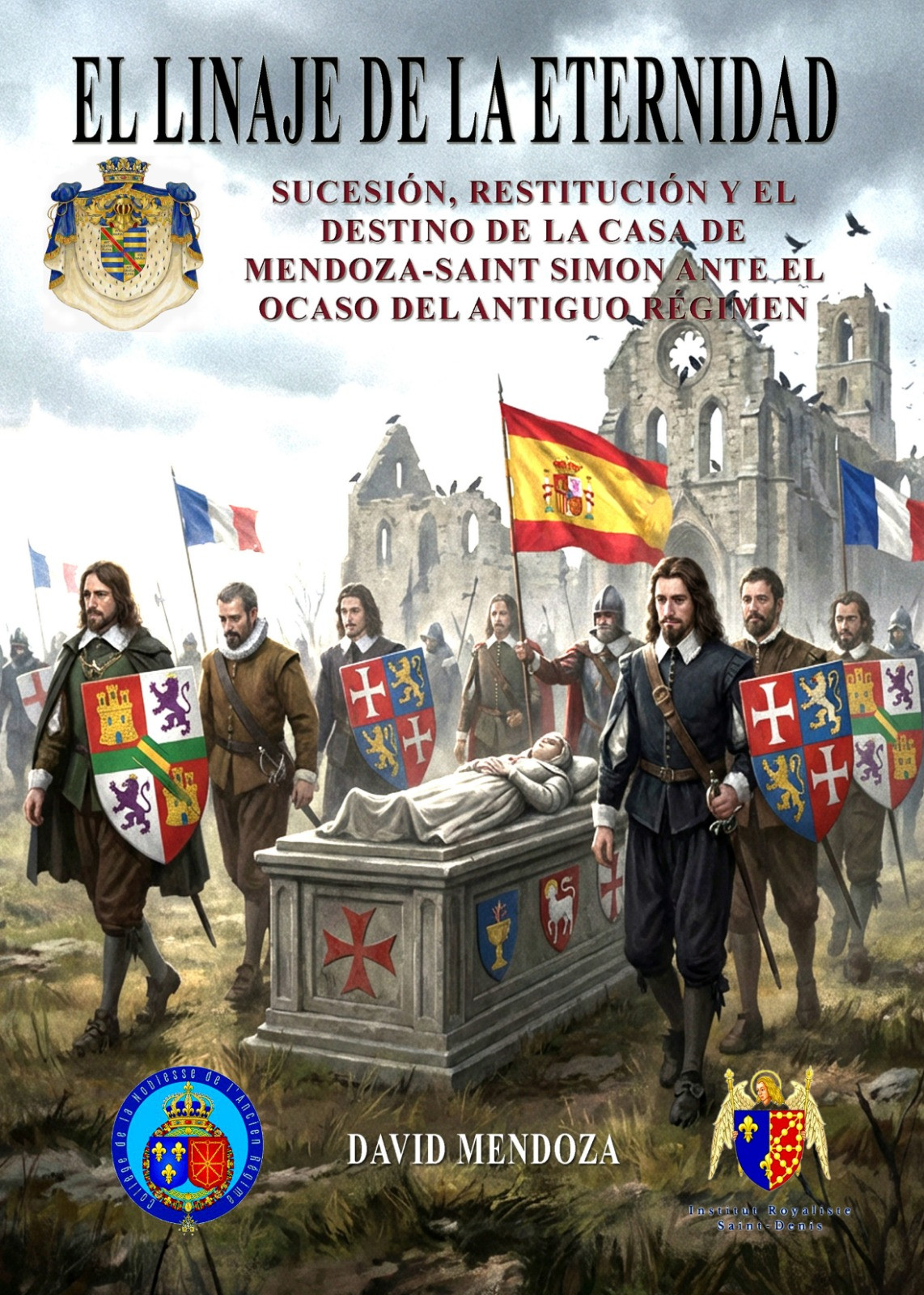
La Eternidad del Linaje: Un Puente Histórico entre los Mendoza y Saint-Simon
ART ESP / ING
Palabras Clave: Casa de Mendoza, Ducado de Saint-Simon, José David Mendoza Álvarez, nobleza transnacional, Grandeza de España, derecho sucesorio, heráldica comparada.
En el umbral de una era que a menudo parece olvidar sus raíces, surge una obra que desafía el silencio de los archivos y la erosión del tiempo. El Dr. José David Mendoza Álvarez presenta su más reciente investigación titulada "El Linaje de la Eternidad: Sucesión, Restitución y el Destino de la Casa de Mendoza-Saint-Simon ante el Ocaso del Antiguo Régimen", un volumen de 197 páginas que promete redefinir nuestra comprensión de la aristocracia europea
Una Convergencia Dinástica en la Europa Borbónica
La tesis central de la obra explora la compleja articulación entre la histórica Casa de Mendoza y el linaje francés del Ducado de Saint-Simon
A través de catorce capítulos y cinco anexos técnicos, el Dr. Mendoza Álvarez desentraña cómo la figura de Louis de Rouvroy, el célebre cronista de la corte de Luis XIV, se vincula con la nobleza castellana
Ciencia y Memoria: El Uso del ADN
Uno de los aportes más innovadores de El Linaje de la Eternidad es la integración de la genética genealógica como herramienta auxiliar
El informe genético, detallado en el Anexo IV, identifica la pertenencia del linaje al haplogrupo R1b1b2, característico de las poblaciones celtas de la Europa occidental
Resistencia ante el Ocaso del Antiguo Régimen
El libro dedica secciones críticas al impacto de los decretos de 1789 y la abolición de los derechos feudales en Francia
El autor analiza el estado de "dormitancia nobiliaria", donde los derechos de sangre permanecen latentes a la espera de un reconocimiento formal
Un Legado para la Posteridad
Más allá de los títulos, la obra reflexiona sobre la responsabilidad intelectual de heredar un linaje histórico
El Linaje de la Eternidad se erige así como un testimonio de la "casa que sobrevivió al tiempo", ofreciendo al lector una síntesis profunda de heráldica, derecho comparado y biogenética que restituye una memoria que durante mucho tiempo permaneció fragmentada
--------------------
The Eternity of Lineage: A Historic Bridge Between the Mendoza and Saint-Simon Houses
Keywords: House of Mendoza, Dukedom of Saint-Simon, José David Mendoza Álvarez, transnational nobility, Grandee of Spain, succession law, comparative heraldry.
On the threshold of an era that often seems to forget its roots, a work emerges that defies the silence of archives and the erosion of time. Dr. José David Mendoza Álvarez presents his latest research titled "The Lineage of Eternity: Succession, Restitution, and the Destiny of the House of Mendoza-Saint-Simon Before the Twilight of the Ancien Régime", a 197-page volume that promises to redefine our understanding of the European aristocracy. Published in January 2026, this book is not merely a genealogical compendium, but a historical-critical analysis of the survival of noble identities beyond political borders and revolutionary ruptures.
A Dynastic Convergence in Bourbon Europe
The central thesis of the work explores the complex articulation between the historic House of Mendoza and the French lineage of the Dukedom of Saint-Simon. The author proposes that this union constitutes a paradigmatic case of "transnational nobility," a network of identities that operated through kinship and diplomatic service within the context of Bourbon hegemony.
Through fourteen chapters and five technical annexes, Dr. Mendoza Álvarez unravels how the figure of Louis de Rouvroy, the celebrated chronicler of Louis XIV's court, is linked to Castilian nobility. The research places this encounter within the framework of the Grandees of Spain, a category that allowed sovereignly influential lineages to articulate a common language of honor and precedence.
Science and Memory: The Use of DNA
One of the most innovative contributions of The Lineage of Eternity is the integration of genealogical genetics as an auxiliary tool. Faced with the documentary fragmentation caused by the French Revolution of 1789, the author resorts to Y-DNA studies to evaluate the biological plausibility of the successional lines.
The genetic report, detailed in Annex IV, identifies the lineage's membership in the R1b1b2 haplogroup, characteristic of the Celtic populations of Western Europe. This data reinforces the hypothesis of a common origin in the Atlantic nobility, providing a framework of scientific verisimilitude to the archival documentation that joins the Mendoza family with the Rouvroy de Saint-Simon.
Resistance Before the Twilight of the Ancien Régime
The book dedicates critical sections to the impact of the 1789 decrees and the abolition of feudal rights in France. While in the neighboring country the nobility suffered a total legal rupture, Spain maintained an environment of greater legal continuity, allowing the memory of the House of Saint-Simon to find refuge within the structure of the Mendoza family.
The author analyzes the state of "nobiliary dormancy," where blood rights remain latent awaiting formal recognition. In this sense, the Mendoza-Morón line is presented as the depository of the "best blood right" for the rehabilitation of the Saint-Simon honor today.
A Legacy for Posterity
Beyond titles, the work reflects on the intellectual responsibility of inheriting a historic lineage. Dr. Mendoza Álvarez, a documented descendant of this lineage, emphasizes that nobility in the 21st century is, above all, a structure of memory and a network of identities that survives when there is a will to investigate and narrate its history with rigor.
The Lineage of Eternity thus stands as a testament to the "house that survived time," offering the reader a profound synthesis of heraldry, comparative law, and biogenetics that restores a memory that remained fragmented for a long time.